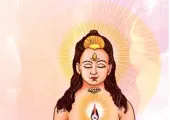
Sanatan Dharma
Linking religion with sect or religion is actually limiting the understanding of religion, since the western world is associated only with sect or ‘faith’, hence being ignorant of the Indian viewpoint, it keeps calling ‘Dharma’ as ‘Mazhab’ which is absolutely wrong, in reality the only pure religion is ‘Sanatan Dharma’, all the rest are just its branches i.e. ‘Sampradaya’ and ‘Panth’. Religion is not limited to humans only, it is spread in the entire world/universe; living and non-living things including animals, birds and trees, apart from the five great elements are also governed by Dharma, in reality Dharma is the driving force of nature! Dharma is that sacred ritual which purifies the consciousness. Dharma is that element by whose conduct a person is able to fulfill his life. It is the influence of the development of human qualities in man, it is the good intention of the universal consciousness. The interpreters of medieval religion considered every activity in the world as the will of God, philosophers propounded the reason for the misery of a person's present life in the formula of 'Karma-Siddhanta'. The result of this in the medieval period was that the cause of all the present troubles was considered to be 'fate' or God's will. The misery of the society or the country was considered its destiny. The society itself became fatalistic and remained satisfied with its happy and sad situations.
Today's era has given this awareness that man has to make the path of development himself. The solution of the problems of a society or country is possible through skill, system-change, scientific and technological development, hard work and devotion. Today's man is more interested in improving his present life. His focus is not 'future-oriented' but on the present. He is engaged in the effort to bring divinity down to his own earth. He is desperate to make the earth itself a heaven. That is, he is moving towards the reality of Sanatan.
Branches of present-day Sanatan
Hindu is the oldest - the stem of Sanatan
The Hindu Sanatan group believes that there is only one religion in the whole world, the eternal Sanatan Dharma. The religion that has been in existence since the origin of the universe is called Sanatan Dharma. Apart from this, all other sects, religions, mazhabs, sects are just that. The religious books of Hindus are Vedas, Aranyakas, Upanishads, Shrimad Bhagavad Gita, Ramayana, Puranas, Mahabharata etc. Vedas are pure spiritual and scientific texts. Vedas are the ocean of eternal truth knowledge beyond the definition of western religion and the beliefs and philosophy of sects and sampradayas. Vedas have been composed to introduce humans to true knowledge. Vedas do not represent sects, sampradayas, mazhabs, religions etc., but are only and only for humans.
Jainism - the first branch of the Sanatan stem
Jain Sanatan group believes that this world, which is a point, has been going on since time immemorial, and will continue to go on till eternity and civilization will keep on developing continuously. Those who have conquered themselves, that is, have conquered attachment, passion, hatred, are Jains, that is, those who follow them. God does not exist separately, but a person can become God by practicing the meditation of his pure soul. God does not do anything, he only knows, everything happens due to the rise of one's own karmas. There is no bondage, you think, understand, contemplate, then do whatever you feel like doing as soon as possible. Jain Sanatan thought is the only such thought in the world which gives freedom to a person. In Jain Sanatan thought, there is no salutation to God, but there is salutation to his qualities.
Second branch of Buddhist- Sanatan stem
Buddhist Sanatan group is a true eternal, system derived from Shramana tradition. It is believed that through this Sanatan all other religions and sects have originated (Es Dhammo Sanantano- Lord's teachings in Dhammapada). This is called the pure Satyasaddhamma path. There have been Buddhas even before Lord Gautam Buddha. The founder of the Buddhist group is Buddhahood himself, not Lord Gautam Buddha. He has given great teachings by converting Dhammachakka and carried forward the eternal tradition of the Buddhas. The Buddhist group denies the existence of God and the centre point of this group is human being. Buddhists believe in the principles of Dharma and Karma, which were propagated by Tathagata Lord Gautam Buddha. Buddhists bow to Lord Gautam Buddha. Tripitaka is the Buddhist religious text.
Abrahamic - Western branch of Sanatan
Abrahamic, the western branch of Sanatan, believes in one God and considers Abraham (Arabic - إِبْرَاهِيْمُ ) as a prophet of God. These include Judaism, Christianity, Islam and Baha'i ideology, etc. These ideologies developed in the Middle East and are monotheistic. Jewish tradition is one of the oldest ideologies in the world.
It is not a formally established sect, neither does it have any followers nor does it have any foundation. Experts even say that it is just a spiritual project whose aim is to eliminate the differences between Islam, Christianity and Judaism by looking at the similarities between them and generally these three religions are placed in the category of Abrahamic religion. Jewish tradition claims that the Twelve Tribes of Israel descended from Abraham through his son Isaac and grandson Jacob, whose sons collectively formed the nation of the Israelites in Canaan; Islamic tradition claims that the twelve Arab tribes known as the Ishmaelites descended from Abraham through his son Ishmael in Arabia; Bahá'í tradition claims that Bahá'u'lláh was a descendant of Abraham through his wife Keturah. Even after a century of archaeological investigation, no evidence has been found for these historical patriarchs. Most scholars believe that the story of Abraham originated in the sixth century BCE, and that the Book of Genesis does not represent historical events.
Christianity - the school of thought propounded in the Mediterranean region of Europe after Jainism and Buddha
In Sanatan, the school of thought propounded by Jesus Christ 2024 years ago in the West i.e. Central Asia and the Mediterranean region of Europe after Jainism and Buddha, is a sect divided into more than 43,000 sects followed by the maximum population of the world in the form of Christianity. This sect believes that God is a soul and the soul does not have bones and flesh, how can we make an idol of that which we cannot see? No one has ever seen that Almighty God with physical eyes. But God showed his love for mankind in this way that he took the form of a human. That Almighty God who created time, time and man. He himself came confined in his time, so that mankind can get rid of their sins through him. This religion spread like a revolution till the fourth century, but after this, the dominance of excessive rituals and religious authority in Christianity pushed the world into the Dark Age. As a result, since the Renaissance, more emphasis is given on spiritual transformation rather than rituals. The Christian scripture Bible has two parts. The first part is called the Old Testament, which is a version of the Jewish scripture Tanakh. The second part is called the New Testament and describes the teachings, miracles and works of Jesus Christ and his disciples.
Islamism - Arab and North African branch of Sanatan
Islam (Arabic - Al-Islam) is a monotheistic Abrahamic religion derived from a prophetic tradition. It started in the Arabian Peninsula in the beginning of the 7th century, around Hijri 1445 BC i.e. {wwAD). According to Islamic tradition, Islam is based on the teachings of the Quran, the book revealed to humans by Allah's last prophet Muhammad, and it includes Hadith, Sirat un-Nabi and Shariat texts. Sunni, Shia, Sufi and Ahmadiya communities are prominent in Islam. The religious places of Islam are called mosques. Islam is the second largest religion in the world according to the total population of followers. Islam is based on the Quran. Its followers are called Muslims. Islam believes in only one God, whom Muslims call Allah. Hazrat Muhammad is considered to be the last and greatest messenger (Prophet or Rasool) of Allah. Worship of gods and idols is prohibited in Islam. The word Islam is pronounced from the Arabic language (Salm). It means to be peaceful, or to surrender; a person attains real peace only by surrendering to God. According to Islamic beliefs, God created the first human (Adam) and sent him to earth and made a 'couple' from him, which started the process of procreation! This procreation continues uninterrupted. And this is the second most populous ideology in the world, divided into 72 sects and 533 communities. For Islam, all the religious books given by Allah to the messengers are valid. According to Islam, the Quran is the last religious book given by God to man. Four more books are important in the Quran- (1) Sahuf e Ibrahimi which was given to Prophet Ibrahim, (2) Torah which was given to Prophet Moses, (3) Zabur which was given to King Dawood, (4) Injeel which was given to Prophet Jesus. Muslims believe that Jews and Christians have changed the messages of their books. According to the beliefs of Muslims, the human race got divided into two main parts- (1) One group lived their lives by devoting themselves (Muslims) to the principles (knowledge) given by the divine messengers, (2) The second group lived their lives by adopting the attitude of their limited knowledge (speculation, conjecture) and turning away from the divine messengers (Kafir).
Sikhism - the stem of Sanatan, a branch formed for the protection of Hinduism
The Sikh Panth group (Khalsa or Sikhmat; Punjabi) is an ideology started by Guru Nanak Dev Ji in the 15th century during the Mughal Sultanate on South Asia (1556-1707) to protect the human rights of the people. The religious texts of the Sikhs are Sri Adi Granth Sahib or Guru Granth Sahib and Dasam Granth. In Sikhism, their religious place is called Gurudwara. Generally, there are ten Satgurus of Sikhs, but in the religious text of Sikhs, there are the Bani of thirty Bhagats including six Gurus, whose teachings are considered important for following the Sikh path.
Charvaka and Communism - Groups of those who do not believe in God in Sanatan
Since the Vedic period, the group that does not believe in the Vedas and God is considered to be the ideology of Charvaka. The texts related to this ideology are almost unavailable. The Manifesto of the Communist Party (Manifest der Kommunistischen Partei) propounded by Karl Marx and Friedrich Engels was originally published in London in 1848 due to the inhuman exploitation and oppression of agricultural and industrial workers at the time of the Industrial Revolution in European countries like Persia, Britain, Germany, France, etc. With the slogan ‘Workers of the world, unite! You have nothing to lose but your chains’, the Manifesto ends with a decisive and famous call for solidarity, concluding, (1) Capitalism does not offer humanity the possibility of self-realization, instead it ensures that man remains backward and alienated forever, (2) Capitalism will bring about its own destruction by polarizing and unifying the proletariat, and a revolution will lead to the emergence of communism, (3) a classless society in which ‘the free development of each is the condition for the free development of all’. Marx and Engels propose the following transitional policies- (1) Abolition of private property in land and inheritance; (2) the introduction of a progressive income tax; (3) the confiscation of the property of rebels; (4) the nationalization of credit, communications and transport; (5) the expansion and integration of industry and agriculture; (6) the introduction of universal obligation of labour; and (7) the provision of universal education and the abolition of child labour. This latest branch of Sanatan comprises more than a third of the population.
So who is man?
Man is responsible for the rise and fall of civilisation whether he believes in God or not. The eternal truth is that a human being is born naked and helpless after staying in the mother's womb for nine months. In the full life span of about 100 years, he learns, sees and experiences some ways of living according to the circumstances by staying under the care of parents for about 10 to 15 years. At the age of 16 to 20, he starts doing something and getting attracted to the opposite sex according to the law of heredity of nature and starts feeling like forming a pair. Till the age of 50-60, he is engaged in earning money and resources and forming and nurturing a family. Till the age of 60-70, he sees the birth and fall of his children and gradually starts feeling old. Death comes between 70-100 years. No matter how capable or wealthy he is, it is not known where death takes him, making him even more helpless than the condition at the time of birth. In an attempt to understand this process, innumerable texts ranging from Vedas to Communist Manifesto have been written, made and are being made, but every living being in the universe (including plants) is afraid of death. Some feel it but cannot do anything, some become the natural food of others and some come out as different substances. Humans keep doing research on all the processes. Every dead person becomes the seed of his own group as the semen of the father and mixes with the menstrual blood of the mother and then is born in an unknown place under unknown circumstances and then starts his life journey of a maximum of 100 years, again accepting death, to be born again according to Hindus or to wait in the grave till the Doomsday according to Islam. It is not necessary that if a human is born, he will live for 100 years, he can die in the womb itself, he can die as soon as he is born, he can die anytime and anywhere in childhood or youth or old age. I don't know why he has come, I don't know what he has come to do, I don't know who has sent him, I don't know what will happen in the next moment, yet as long as he breathes, thinks, wanders, contemplates, fights, quarrels, sleeps, wakes, does some work directed or voluntarily and then merges into the unknown, this is Sanatan, everything else is just the footprints left by man in the form of seeds billions of years ago, aligned with the memories of time and situation based experiences of infinite knowledge and system chains! Then all are Sanatan, neither Hindu, nor Jain, nor Buddha, nor Christian, nor Muslim, nor Charvak, nor Communist! All of them are children of that supreme power who, evolving from a single-celled organism, have been coming and going in the continuous cycle of movement of humanity and divinity since unknown time and will keep coming and going till unknown time! So be it.





.jpg)