


The oldest tradition of History writing is known to have been in India. In Europe 150 years ago no subject called 'History' was taught at all. The word 'History' was created in the 19th century AD from 'Story', in which the capital 'H' is used in English to mean 'God' or 'Emperor' by adding the letter 'H' to the beginning. Therefore, the stories of kings are 'History', whereas as it happened in human history i.e. in the course of time, its history is the same and deep-cut description. But the tradition of writing 'History' which has gradually developed in Europe in the last 150 years has not been followed even by intellectuals protected by a strange type of Indian rule for 75 years. here in a different way, strangely History has been written. When each nation or state writes its history, it writes its people and its rulers in mind.
Maharana Pratap was the Chakravarti emperor of India in the latter half of the 16th century AD. A short time later, a disintegration occurred. But within 50 years, Shivaji emerged as a great devout and unique general to fill that gap. He and Maharaj Chhatrasal together again established Rajdharma on the land of Bharat. Fearing both, and after betraying and betraying Maharaj Jai Singh and Maharaj Jaswant Singh, the Rajputs also abandoned him and because of his betrayal with the Jats, the Jats began to attack his residence in Agra and Fatehpur Sikri repeatedly. Fearing all this, Muiuddin, who used to call himself Aurangzeb, left his capital of Fatehpur Sikri, wandering from place to place in the south and fighting sporadic battles and died in the city of Gujarat also. He died in the kingdom in which he was born and his grave was repeatedly changed in terms of place.
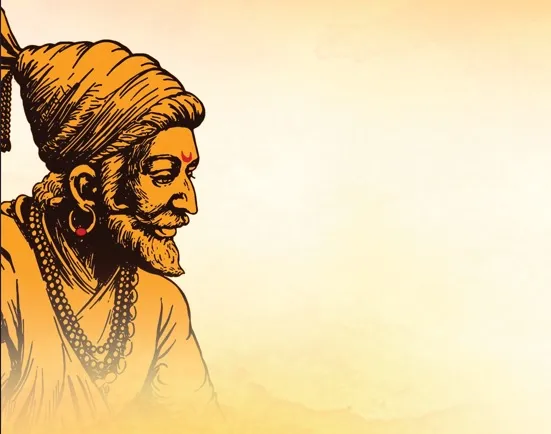
Shivaji was born on 19 February 1630 AD in Shivneri Fort of Junnargarh and died at the age of 50 in Raigad Fort of 'Hindavi Swaraj'. It is clear from this that he was born as a king and left the world as an emperor. If you compare it with Muiuddin, then the situation will become clear. Muiuddin was born on 3rd November 1618 at a common place in Dahod, Gujarat and died in a military tent near Ahmednagar in Gujarat itself.
Due to his constant involvement in the war, Shivaji's brave father Shahji entrusted the responsibility of education, initiation and rites of Shiva to Grandfather Kondadev Kulkarni. Mata Jijabai was the darling daughter of Raja Lakhuji Yadav and Mahalsabai Yadav of Devalgaon, who married Shahaji Bhonsle at the age of 16. Mother Jijabai belonged to the family of Yadav emperors and she assimilated the great tradition and rituals of the Yaduvanshis. Born in the lineage of Lord Shri Krishna, Mother Jijabai and religious Brahmin Grandfather Kondadev instilled in Shivaji the values of piety, patriotism, bravery, brilliance, tactical and diplomacy from adolescence. From adolescence, Shivaji proved his uniqueness and uniqueness with the rites of his own forefathers. Later, with the inspiration of Samarth Swami Ramdas, he went on to become the master of an even more advanced personality.
In the 19th century AD, the East India Company's employees, fed up with the self-respect of the Hindus, declared them fake history with the intention of humiliating them. His declaration is evident in the very first volume of the multi-volume book edited by Elliot and Dawson. Without any Indian evidence, he created inferiority-filled gossip among Hindus, exaggerating the persecution and malpractices of Muslims hundreds of times by citing alleged copies found in Turkey and elsewhere in Central Asia. Later on, it was taught as history because it is easier for prodigious writers to copy the gossips of firangis in place of the records available in different states in India. That is why Shivaji's revered father Shahji is shown as a subordinate to the Muslims and the truth of the Bahmani and Adilshahi Jagirs is hidden.
Hassan Gangadhar, the son of a Parsik protectorate of the Brahmin king Gangadhar Shastri, founded the Bahmani Jagir. In the 20th century AD, i.e. after 600 years, Muslim writers started calling him Hasan Gangu. The truth is that all the important posts in the Bahmani jagir, including commanders, kosha chiefs, etc., were held by Hindus only. The official languages of the Bahmani Jagir were Marathi, Kannada and Parsik languages. Indian music, dance and arts were patronized there. Adil Khan, a servant of the same Bahmani Jagir, later created his own separate Jagir. Adil Khan till the 19th century AD He was called, because he used only his Mongol title. The work of giving the title of Shah to all of them was also done in the forged compositions of the British. Later the Hindu disciples of the British accepted the same as the truth.
The truth is that the original founder of the Adilshahi Jagir was Yusuf Adil Bahmani (founded by a Brahmin son) a chief servant of the state. He was Sanatan Dharma and established his influence by marrying Punji, sister of Maratha king of Indapur. Maratha Veerangana Punji was a skilled warrior and on the death of her husband, she valiantly resisted the attempt to capture the jagir by some vassals, dressed as a man, and placed her son on the throne of Bijapur, and that is why the Marathas continued to have a proud relationship with the throne of Bijapur. This is the reason why Shiva's father Shahji also got involved in protecting the throne of Bijapur in the event of a crisis. The fools have called it the subordination of the Turks without knowing the condition and tradition of India and now even the thunderbolt fools have started calling it the subordination of the Muslims.
The name of Yusuf's commander in chief was Kalidas Madhu. Punji kept him as the general even later and he also served Ismail Adil Khan. Ibrahim Adilshah built Gagan Mahal in this manor. In this dynasty, Chandbibi, wife of Ali Adil Khan, fought the forces of Jalaluddin (Akbar) valiantly. Chandbibi was well versed in Marathi and Kannada, was proficient in archery and horse riding, and was proficient in Carnatic music, and her main hobbies were composing and grooming flower gardens, and playing the veena. She was completely an Indian heroine. Thus both the Adilshahi Jagir and the Bahmani Jagir were mainly jagirs dominated by the Marathas and that is why Shahji also rendered his services there with an intuitive spirit. Wicked Sufis spread Islam by cunningly interfering in these jagirs and Islam became dominant there in the 16th century AD but continued to co-exist. In the 20th century AD, first the British and then their Hindu and Muslim disciples, showing mutual agreement on this subject, promoted these jagirs as purely Muslim jagirs and started calling the Hindus posted there as their slaves, which in itself was a punishable offense. is a crime. Presenting history as Hindu-Muslim war in this way is the result of intellectual madness and lack of education.
Developed under the patronage of Jijabai, the Tejaswini daughter of Grandfather Kondadev and Lord Krishna's lineage, Shivaji had taken control of the Torna fort at the age of 16. Apart from there he also conquered the fort of Purandar, the fort of Kondana and the fort of Chakan. He also conquered the jagirs of his ancestors, Indapur, Baramati and Supa. Soon he got Raigad Fort built and built his capital there as well. By the age of 25, Shivaji had snatched the forts of Kalyan and Panhala from the Turks. He also established his suzerainty over the manor of Javali near Mahabaleshwar. The Bhonsle, More, Ghorpade, Nimbalkar, Sawant, Shirke and Mohite Maratha clans were also closely related to the Bijapur throne. These people had the titles of Deshmukh. Shivaji, while dealing with diplomacy and diplomacy, mixed them all on his side and married Soyarabai Mohite, Putlabai Palkar and Sakvarbai Gaikwad and Kashibai Yadav.
Adilshah started getting restless due to the increasing power of Shivaji, so he sent Sunni Muslim Afzal Khan to fight with Shivaji in 1657 AD. The Turkic forces created a ruckus and desecrated the temple of Mata Tulja Bhavani and the Vithoba temple of Padharpur. For about a year and a half, many battles took place between the armies of Afzal Khan and Shivaji, but Afzal Khan could not capture the Pratapgarh fort, where Shivaji was. Then he sent a fraudulent proposal of treaty and hatched a plan to assassinate Shivaji in November 1659 AD. The brilliant and visionary Shivaji had already sensed his wickedness and met with preparation and when 40-year-old Afzal Khan wanted to kill Shivaji with a katari, about 29-year-old Shivaji tore his liver with a thong. The following year Shivaji also captured the fort of Panhala. The number of Bijapu army was very high and at that time Shivaji's power was reduced due to many wars. So he proposed a treaty. But the Bijapuri general named Siddi Jauhar made a secret treaty with the Firangis and wanted to kill Shivaji by treachery. Meanwhile, the East India Company, having entered into a treaty with the Vijayanagara Empire, had obtained many trade facilities in Chennai and was spreading its spread in India with crookedness, claiming itself to be the servant of the Hindu kings and sometimes the Muslim Nawabs. When Shivaji came to know about the deceit of Siddi Jauhar, he withdrew the proposal of the treaty and the Firangi merchants returned to Rajapur. The factory was also taken over. In the end, Siddi Johar made a treaty after being compelled. Siddi Jauhar again betrayed and Shivaji had to hide in the fort of Vishalgarh with 300 soldiers. The Maratha general Bajiprabhu Deshpande, showing unmatched valor in Ghodkhind, held the huge Turkish army and Bajiprabhu put his life in it. They fought till the sound of guns came from the fort of Vishalgarh. That voice was the information of Shivaji reaching the safe fort. Since then Shivaji renamed Ghodkhind as Pawan Khind meaning Holy Pass.
After this, when the elder Begum of Bijapur requested Muiuddin (Aurangzeb), she sent Shaista Khan along with many Rajput generals along with one and a half lakh soldiers. Many forts of the Marathas came under the enemy's possession due to the bravery of Rajputs, but brave Shivaji boldly attacked Shaista Khan's camp in the night with only four hundred Marathas and he started running. While running away, his three fingers were cut off by the sword and many relatives and soldiers including his son were killed. Shivaji captured Surat. Then Muiuddin sent the famous brave general Raja Jai Singh to defeat Shivaji. The war lasted for several months and in the end both sides made a treaty. The Treaty of Purandar took place on 11 June 1665 AD. Raja Jaisingh assured that Muiuddin would respect you. Let's meet you Believing in Raja Jai Singh, Chhatrapati Shivaji went to meet and there Muiuddin betrayed him and took him captive.
Chhatrapati Shivaji skilfully escaped from Agra and after that Muiuddin's position began to falter. He accepted the title of Raja of Shivaji and started addressing him as Raja and again sent Maharaj Jaswant Singh to Shivaji with the proposal of treaty, but this treaty lasted only a short time. Suddenly Muyuddin felt that his son Muazzam had met Shivaji and then in fear, he sent Turkish armies to capture the Berar area. With this the war started again and Shivaji captured many forts within four months.
The coronation of Chhatrapati Shivaji Maharaj was done on Jyeshtha Shukla Trayodashi Vikram Samvat 1731 AD (6 June 1674 AD). At that time he was the most capable Chakravarti emperor of India. The status of Muiuddin (Aurangzeb) was nothing in front of him. In fact, by then the actual rule of Mu'id-din had remained in a very small area. Rajputs had separate kingdoms. The rule of the Bundelas was completely independent and it had no real influence in South India. Among the Rajput kings, he first broke his promise with Maharaj Jaisingh and then betrayed Maharaj Jaswant Singh.
After this betrayal, the Rajputs became angry with Muiuddin and made a distance. After this the Rajputs stopped cooperating and the Jats started attacking Muiuddin's Agra fort repeatedly. Fearing whom Muiuddin fled to South India and pretended that we had set out for the conquest of South India. In the end he wandered for 26 years, almost to a state of oblivion or notoriety, and died in a military tent.
Some people call themselves historians and tell that after Aurangzeb, his empire disintegrated. This is ridiculous. In fact, during the time of Muiuddin (self-proclaimed Aurangzeb), his so-called empire, which was actually a Hindu-Muslim common rule, was shattered due to his folly. The Rajputs stopped patronizing and supporting him. The Jats increased their attacks on him. The Bundelas were keeping their own kingdom and the vast area of Godwane was ruled by the descendants of Queen Durgavati. On what basis Muiuddin can be called the emperor of India, only the disciples of the British can tell. It is known to all that the Marathas and the Rajputs were the only ones holding key positions in the administration of Muiuddin. It is true that he kept trying to fool everyone to become a Muslim, but no important Maratha or Rajput general became a Muslim. Taking a chance, Muiuddin broke the temples of Sanatan Dharma many times and donated many times to other temples. The British propagated his atrocities a hundred times more than what they were and their disciples are repeating it. He repeatedly tried to persuade the great Guru Tegh Bahadur ji to become a Muslim, but instead of giving up religion, he chose to give up his head. It is well known that Guru Tegh Bahadur had studied the Vedas, Upanishads and Puranas and did penance and he was also proficient in wielding bow and arrow and horse riding. After his marriage to Mata Gujri, he expanded the cult even more and built temples at many places, which later came to be called Gurdwaras. He also started the langar system.
Frightened by the expansion of Guru Tegh Bahadur, Muiuddin was placed on the throne. There was danger. Sufi Adam, a disciple of Sheikh Ahmed Sirhindi, provoked Muiuddin and wrote many letters against Guru Tegh Bahadur saying that this man threatens your throne. On this Muiuddin was furious and he increased the pressure on Guru Tegh Bahadur. In the meantime, Muiuddin also pressurized Kashmiri Brahmins to become Muslims and in the process clashed with Guru Tegh Bahadur. Muiuddin imprisoned three of Guruji's associates, Bhai Matidas, Bhai Dayaldas and Bhai Satidas. Bhai Matidas was cut with a saw, Dayaldas was boiled in boiling water and Satidas was burnt alive. After this Guru Tegh Bahadur's head was publicly beheaded in Chandni Chowk. Due to all these atrocities, Sikhs also became very angry with Muiuddin and for this reason he had to flee to South India to save his life from Sikhs, Jats, Rajputs, Bundelas etc.
The truth is that due to Shivaji and his successor, the great general, Bajirao Peshwa, by the beginning of the 18th century, more than three-fourths of India had come under the control of the Marathas. This was stated by Randolph G.S. in the book 'The Anglo Maratha Campaign' published by Cambridge University Press. Cooper said in the role on page 8. Chhatrapati Shivaji Maharaj died in the last phase of the 17th century and his brave followers and generals established Hindavi Swaraj throughout India within 60 years. They had a treaty with the Rajputs, but later on the arrival of the British, due to their political ambition, the Rajputs opposed the Marathas and made a treaty with the British.
Chhatrapati Shivaji Maharaj, at the time of his coronation, followed the rajdharma enunciated in the Dharmashastras and ran his administration according to the scriptures. The efficiency, dexterity, orderliness and soundness of his administration are being studied all over the world. He also built a strong navy. 400 warships were always ready in his place. In the Navy, he kept a large number of fishermen as soldiers and also kept some Muslims loyal to him and also made Portuguese sailors in the Navy. It is a different matter that the Portuguese sailors turned out to be traitors and joined the Portuguese army. After Chhatrapati Shivaji Maharaj, Chhatrapati Shahuji Maharaj continuously expanded the Maratha Empire for 50 years. His chief generals Balaji Vishwanath and Bajirao Peshwa I inscribed their war strategy and valor on world history. There has not been any commander bigger than Bajirao Peshwa in the post-Mahabharat war world till date.
लेखक
Advertisment

Latest News
01 Jan 2025 17:59:59
India of our dreams 1. Become a true Sanatani All of us, the descendants of Rishis and Rishikas, should follow,...
.jpg)



.jpg)