Under the conspiracy of British rulers, Macaulay had started English Education in 1835 to instil a sense of inferiority complex in the minds of the entire Indian society. He had aimed at preparing such people whose blood and organs will be Indian but at the same time their thoughts and aptitude will look English. They will work as interpreters between the rulers and citizens'. After declaring it, Macaulay wrote a letter to his father-- I believe that if our education system is implemented, there will be no idol worshipper in standard family of Bengal after 30 years. There will be no need of interference in religious freedom.
From William Vilchar Force to many Britishers launched an agitation in England from 1780 that the setting up of British empire aimed at not only earning money but expanding Christian religion.
Many British officers including Macaulay were of the view that until we set up Christian religion in India, we cannot stay in India. Therefore, the only one way to change Hindus into Christians is to implement English education system in the country. Judiciary, revenue, governance and economy of any country is based on the education system. If we change the education system, the functioning of all these gets changed. The Britishers were of the view that 'it was education which could change the human being'. We should decide the lifestyle, family, national economy, social and political structure of people before selecting an education system.
Due to Macaulay's education system, India's the 200 crore years old Indian spiritual culture got affected by western materialistic culture. It affected the mindset of modern youths of India.
In the present education system, the ideals, theories and ideologies of west are being glorified. Macaulay's wrong education system crippled not only political but also social, economical, religious and cultural fabric of India. However, the English education system was one of the reasons behind our obtaining freedom but at the same time, social, economical, religious and cultural thoughts got adversely affected.
Macaulay's education system has changed the brain programming of Indian youth to such an extent that they started to glorify western culture, atheism, pseudo secularism, unscientific development, unnatural sex, disrespect of India's greatness. It pollutes the minds of Indian youths who started to believe in the gospel 'earn, eat and enjoy'.
In the current education system, when the children of 3-4 years of age enter the play school, they are brainwashed with western thoughts. They are turned into consumers so that their inner conscience is filled with falseness, greed, violence, hatred, jealous, hate, sex, non-vegetarianism, porn, illegal, atheism instead of truth, non-violence, tapa, sacrifice, service, yoga, spiritualism, love, purity, celibacy, satisfaction and peace.
Ideological effect of education system
If we talk about brain programming, Osama Bin Laden inflicted pain to the entire world despite having higher education in Civil Engineering. Similarly, Afzal Guru, who was hanged, was a university professor.
If we find out the causes behind these incidents, we see that Osama's brain was instilled with hatred and radical thoughts. The modern education makes us literate, while Indian Vedic tradition or rishi tradition makes us good persons. Maharshi Dayanand says-- the education aims at instilling a sense of enlightenment in the human being. Similarly, Maharshi Arvind says that the human being can get enlightened by developing his inner conscience through the Indian education system and yoga.
According to Maharshi Arvind, the education helps people get enlightened. Maharshi Dayanand was not satisfied with the current education system. He said that information can't be the foundation of intelligence. Maharshi Arvind was in favour of Indian gurukuliya tradition in which the teacher plays the role of friend of his students. The teacher boosts the moral development of the students.
Factual details of education, literary and gurukuliya system of ancient India. During the second Round Table Conference at London on October 20, 1931, Gandhiji alleged that the British Raj demolished the Indian education system and the Indians became illiterate after 100 years of British rule. Many Britishers opposed Gandhiji's statement. Gandhiji presented old evidences and data. On the basis of a survey of the documents of various representatives of British, he proved that the population of Madras Presidency was 1, 28, 50, 000. There were 12, 498 gurukul where around 1, 88, 000 students were getting education. If we compare British education system with Indian education system, we find that the educational condition of India was three times better than that of England. There was not much difference in the population both India and Britain at that time. The number of British students was around 75, 000 out of which most of them go to the schools for attending Bible class for 2-3 hours on Sunday. It proves that Indians were three times more educated than the Britishers.
World famous education centre in ancient India
World's first university Takshashila was set up in India around 2800 years ago. Nalanda University was established in the 4th century BC. Apart from that, the residues of Vikramshila University, Vallabhi University, Udantpuri University, Sompura, Pushpagiri University are the evidence of world famous education centres.
Beginning of transformation movement against Macaulay's education system
The repercussions of English education system emerged in 18th century. Ravindra Nath Thakur's father Devendranath Thakur, Yogi Arvind's maternal grand father Rajnarayan Ghosh, Bankim Chandra Chaterjee, Maharshi Dayanand Saraswati, Swami Vivekanand, Bhagini Nivedita, Anne Besent, Ravindranath Thakur, Sri Arvind, Swami Shradhanand, Lala Hardayal, Mahatma Gandhi had declared this foreign education system worthless.
In order to check the repercussions of the British education system, Ravindranath Tagore's father Devendranath Thakur had set up a school in 1845 providing free education to the children through Tatvabodhi sabha. Rajnarayan Jee also reviewed the repercussions of English education system and initiated the first step of national renaissance through 'society for the promotion of national feeling among the educated natives of Bengal
'Students literary and scientific society and 'Dakkan Education Society' were set up in 1848 for intellectual and moral development. GV Joshi, Mahadev Govind Ranade, Vasudeo Balvant Pharke, Bishnu Shastri Chiplunkar, Bal Gangadhar Tilak and Gopal Ganesh Agarkar participated in this movement.
Bankim Chandra Chaterjee in 1872
Bankim Chandra Chaterjee started to edit 'Bangdarshan' magazine against the western impact on the Bengali society.
Maharshi Swami Dayanand Jee's gurukuliya education in 1874
Swami Jee set up Arya Samaj in 1874. However, he had already set up Vedic gurukuls at Kashganj, Jalesar, Farukhabad, Mirjapur and Kashi of Uttar Pradesh.
Swami Vivekanand in 1893 was of the view that the education is the bunch of information which is instilled in the mind. We must experience those thoughts which are helpful in development of life and human being and character. He hoisted the flag of greatness of Indian culture at Chicago conference in US.
He also drew the countrymen's attention towards demerits of western knowledge and education system. Swami Vivekanand focused on the need of national education system instead of English education system. All the sanyasis of Ramkrishna Mission including Bhagini Nivedita started various experiments in the direction of national education.
When thousands of students joined the Banga Bhanga movement in 1905, then Britishers ordered the college principals to suspend them. The British order boomeranged.
Ravindranath Thakur led a meeting to discuss alternative education in 1905. In the same year, Rangapur national school was started with 300 students. Nationalists convened an education meeting where it was decided to constitute a 'national education council'.
Concept of Ravindranath Thakur's education
He believed in providing education through the mother tongue. He set up four educational institutions. He set up 'Shanti Niketan' school in 1901, 'Sri Niketan', Siksha Satra'. Later, he established 'Vishwa Bharati'.
In 1906, Sri Arvind constituted casteist (national) education council comprising 92 members. He inaugurated National College and Bengal National College and School.
Efforts of Lokmanya Tilak and Lala Lajpat Rai on education
Lokmanya was instrumental in setting up 'National School' at Amravati and Pune in Maharashtra. Lahore became the national education hub under the guidance of Lala Lajpat Rai. Lal, Bal and Pal were the torchbearers of indigenous movement. Bipinchandra Pal set up 'National Council of Education of Bengal' (National Education Council of Bengal). Later, schools were established at Rangapur, Dinajpur, Dhaka, Komilla, Jalpaiguri and Kolkata.
However, the movement fell flat as Sri Arvind Jee, Lokmanya Tilak, Bipinchandra Pal were lodged in jail. The Britishers suppressed the agitators.
Educational movement by Dayanand Anglo Vedic institution in 1883
Lala Lajpat Rai, Mahatma Hansraj, Mahatma Munshiram, Lala Railaram and Pandit Gurudatta Jee decided to set up Dayanand Anglo Vedic College to counter the repercussions of English education. Later, they started to set up many DAV schools in the country.
Swami Shradhanand Jee's educational gurukuliya experiment at Gurukul Kangri- Mahatma Munshiram and his associates separated from DAV society and set up Gurukul Kangri at Haridwar in 1902 to boost gurukulia education based on Indian rishi tradition. Later, gurukuls were set up at Multan (1909), Kurukshetra (1911), Gurukul Indraprashtha (1912), Bhatinda, Bhainswal, Saurashtra (Gujarat), etc.
During 'non cooperation movement' in 1920, the Mahatma Gandhi-led Congress appealed to the countrymen to boycott government educational institutions and set up national schools. National education institutions were set up in all the districts in Maharashtra. Tilak Maharashtra Vidyapeeth was set up as National University in 1921. Bihar Vidyapeeth, Kashi Vidyapeeth, Gujarat Vidyapeeth were set up in Bihar, Uttar Pradesh and Gujarat respectively. Mahatma Gandhi was of the view that -- 'whether we get freedom today or tomorrow, but it will be unstable without education'.
Banaras Hindu University in 1916
Mahamana Madan Mohan Malviya, who was the torchbearer of education of Sanskrit and culture, religion and policy, set up Banaras Hindu University in 1916 in Uttar Pradesh to provide national leadership in the country.
Kashi Vidyapeeth in 1920
Babu Shiv Prasad Gupta and Babu Bhagwan Das Jee set up Kashi Vidyapeeth in 1921 with cooperation from Mahatma Gandhi, Pandit Moti Lal Nehru, Maulana Abul Kalam Azad, Seth Jamnalal Bajaj. Kashi Vidyapeeth played an important role in the freedom struggle. The Britishers banned the Vidyapeeth.
Educational experiment of Sri Maa in Puduchhery in 1952
Sri Arvind's theory is that 'the education can't be imparted, the children themselves get education'. On this basis, he started various education experiments for the transformation of human being without any syllabus and examination.
Gandhiji's education experiment through basic education
Gandhiji set up schools at many places like Vardha, West Champaran, Sabarmati Ashram, Delhi and conducted many educational experiments on basic education, and fundamental education. His spiritual successor Vinoba Bhave played a major role in this movement. Later, the movement fell flat due to British suppression.
Results of educational movements
The great personalities focused on the education pre and post freedom. They tried hard to replace Macaulay's education system. But their efforts went in vain. All these movements became common schools and universities at the levels of syllabus, education system, teacher-student relation, educational atmosphere, speeches of teachers and students, behaviour and character.
Commitment of educational revolution by Patanjali through Indian education board
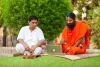
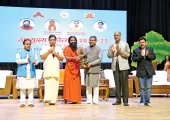
In order to realise the dream of total freedom of martyrs and revolutionaries, Maharshi Patanjali and Charak, Sushrut and Dhanvantari's son yogarishi shradheya Swami Jee Maharaj and Ayurveda great Shradheya Acharya Balkrishna Jee Maharaj are committed to make an educational revolution. Earlier, they had already started yoga revolution, ayurveda and indigenous revolution, regime change revolution for corruption free governance. Through Indian education board, every child will be made a divine world citizen to make India a world teacher.
References
Prof Dharampal Jee: Research book: Sprawling tree of education in India
Sri Arvind birth centenary granthmala
Prof Devendra Swarup: History of national education movements, Pratibha Pratishthan, New Delhi